


Trends Report
The Impact of Age and Mental Health on Claims
It’s well-established that physical, psychological and social factors can impact injury recovery. We’re currently seeing an aging employee population and a higher prevalence of depression and anxiety reported by claimants since the start of the COVID-19 health pandemic. During this time, we’ve also seen lower rates of surgery and a decrease of opioid utilization.
These trends typically result in higher use of physical therapy, thus increasing physical medicine’s share of the work comp medical dollar, but contributing to lower claims costs and better claims outcomes. We expect conservative care initiatives, which include the use of physical therapy, to continue in the future to have a long-term positive impact on claims.

Impact of Injured Employee Age on Physical Recovery
Conventional wisdom tells us that the body takes longer to heal the older we are, and so it may not come as a surprise that the injured employee’s age has an impact on physical recovery. While older employees get injured less frequently, they often suffer more severe injuries and have longer recovery times. With an aging workplace, it becomes increasingly more important for employers to take necessary measures to prevent injuries among the older workforce.
According to the Bureau of Labor Statistics: 39% of the U.S. workforce is expected to be older than 55 in 20261
According to the Bureau of Labor Statistics
39%
of the U.S. workforce is expected to be older than 55 in 20261
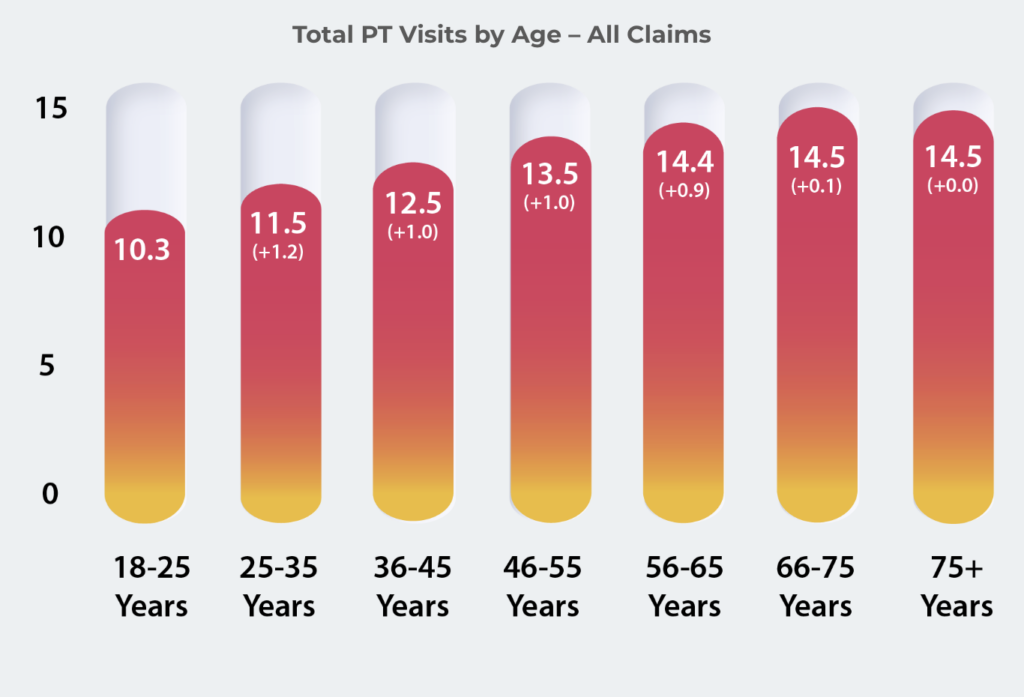
Total PT visits increase by injured employee age.
Across all injury types, MedRisk found that the number of PT visits attended by injured employees increases by about one full visit with each age group up through the 55-65 age bracket where average visits per episode of care remains consistent through the older population.
Injured employees aged 56-75+ have 21% more PT visits than those aged 18-55+
Injured employee age affects PT duration
As you might expect, MedRisk found that as the average number of PT visits increases by age bracket, so, too, does duration. However, while the number of visits remains fairly static in the higher age brackets, duration continues to increase with age. Although injured employees may not be treating for more visits, they are treating for longer.
Injured employees aged 56-75+ have 31% longer duration than those aged 18-55+


Impact of Mental Health and Physical Recovery
1 in 5
50%
25%
Increased rates of anxiety and depression in injured employees.
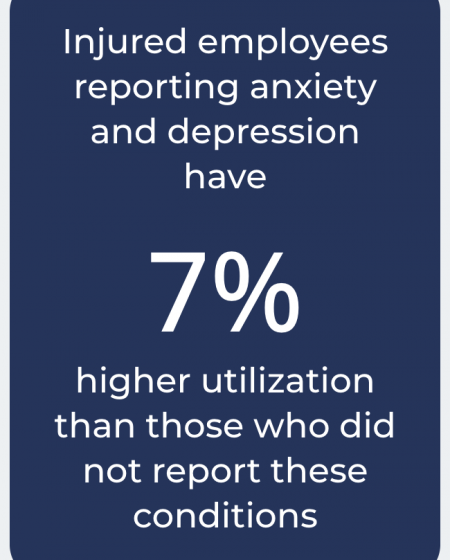
Impact of anxiety and depression on utilization.
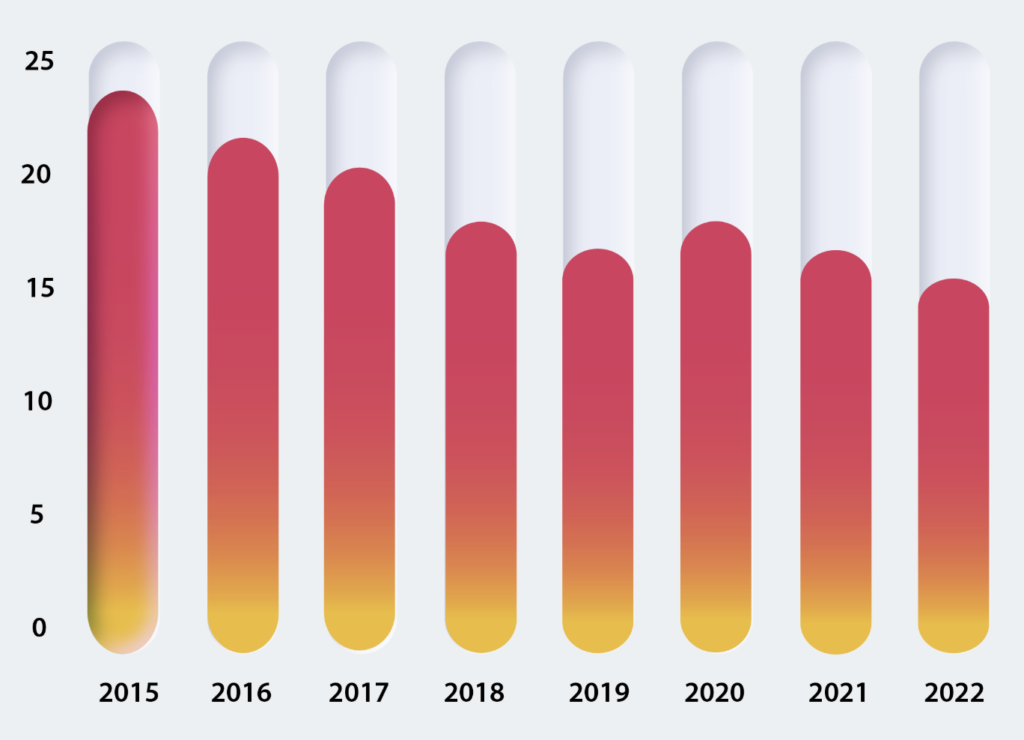
Other Market Trends: Surgery Rates Continue to Decline
Percent of Claims Involving PT with Surgery
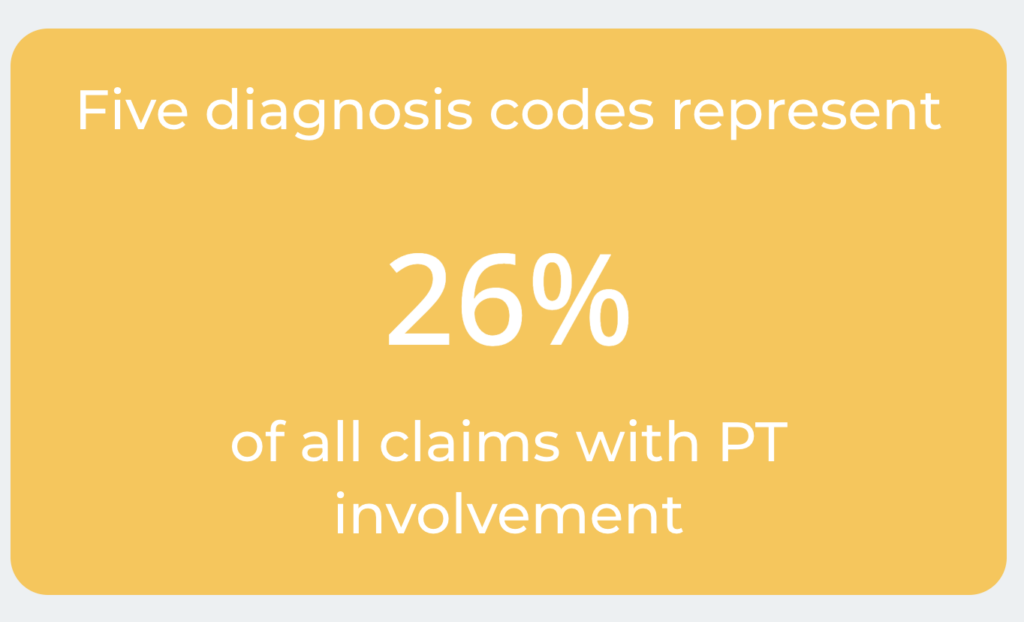
Top Diagnosis Codes
MedRisk By the Numbers
51,3627
16,2271
90%
73%
Texas WC Network Regulation: In January 2022, the Texas Division of Workers’ Compensation proposed revisions to existing WCN regulations, explaining that changes were needed to clarify the provisions and to implement legislative amendments to the Insurance Code. These proposed changes are extensive and bear attention of workers’ compensation system participants. Among the prominent proposed provisions are the following:
Location and service type identification requirements for WCN participating providers have been made much more specific.
Networks must give prior notice to TDI of any proposed change of ownership.
Networks must give prior notice to TDI regarding modifications to network configurations involving telehealth services.
Network contracts and subcontracts with providers must include a statement that a carrier contesting compensability may not deny payment prior to the issuance of a notice that the injury was not compensable.
Carriers and employers must have a documented procedure for determining which is responsible for obtaining signed employee acknowledgements of the employer’s network participation as well as signed copies of the employee acknowledgements.
By September 23, 2022, networks must have a documented credentialing process that meets NCQA or URAC standards.
Networks may only use Texas-licensed doctors to perform in-network utilization reviews.
Implications: Payers, certified WCNs and specialty networks should review their policies and procedures in preparation for TDI’s enforcement efforts based on these proposed regulations.
California MPN Legislation: A once-onerous bill has been brought back to life, but in a much-diminished form. As originally proposed, Assembly Bill 399 would have mandated that MPNs pay participating providers at California’s Official Medical Fee Schedule and would have prohibited negotiated rates below the regulatory fee. The measure would also have restricted MPNs’ ability to review provider bills for mistakes, fraud and abuse. Through intense opposition by WC payers and employers, the bill was held in the Assembly Insurance Committee without being voted on and, consequently, is ineligible for further consideration until the next legislative session. In January 2022, a revised AB 399 was unanimously passed by the Assembly and sent to the Senate. In its current state, the measure merely requires payers to provide employees, within five business days of their request, with the MPN’s name and identification number. The payer may satisfy this requirement by providing the information in writing or an explanation of benefits or by posting the information on a website.
Implications: This legislation can be seen as part of a continuing discussion in California regarding the function and value of registered Medical Provider Networks (MPNs) in delivering timely and accessible health care to injured workers. It is generally recognized in the workers’ compensation community that prompt delivery of health care services improves work-related injury outcomes and independent research has shown this to be the case.
Maryland Cybersecurity Law: In June, Maryland enacted legislation that sets cybersecurity standards for insurers, TPAs and their third-party service providers. According to the National Association of Insurance Commissioners, Maryland becomes the 18th state to adopt a version of the NAIC Insurance Data Security Model Law (#668). Along with the New York regulation “Cybersecurity Requirements for Financial Services Companies” (addressing the same issues but following a different model), the legislation establishes generally accepted data security standards for workers’ compensation payers and their trading partners.
Implications: The provisions of the model act offer a guidepost for payers’ internally developed cybersecurity standards since they are now broadly required by state law. Fortunately, they are reasonable, requiring payers to develop and implement a data security program to identify and protect against risks, respond to data incidents and investigate and disclose cybersecurity events to regulatory authorities and affected consumers and trading partners. Payers are also required to oversee compliance of their third-party service providers using or accessing the payer’s confidential information.
Telehealth
Telehealth Compliance with HIPAA: The Office of Civil Rights (OCR) within the US Department of Health and Services has recently issued guidance broadly endorsing the use of audio-only telehealth services to increase access to health services by patients who have limited financial resources or who live in rural areas with limited broadband availability. The guidance can be found here: https://www.hhs.gov/hipaa/for-professionals/privacy/guidance/hipaa-audio-telehealth/index.html.
Implications: OCR enforces federal privacy regulations (e.g., HIPAA) that generally don’t apply to WC payers, but health care providers and payers’ third-party service providers don’t enjoy those same exemptions, so this clarification comes as a welcome relaxation of regulatory constraints. On a related telehealth topic, a new study from physical therapy quality analytics firm Focus on Therapeutic Outcomes (FOTO) found that, for telerehabilitation for low back pain, telerehab (a) was equally effective in improving functional status outcomes for patients with low back pain compared to traditional in-person office visits, (b) usually involved significantly fewer visits, and (c) had roughly equal patient satisfaction ratings (82% for telerehab versus 86% for in-person office visits.
Ohio Statute Defining Compensability of Work-From-Home Injuries: Ohio has enacted HB 447, which sets standards for WC compensability for injuries incurred by work-from-home employees. Three criteria must be met:
The employee’s injury or disability arises out of the employee’s employment.
The employee’s employment necessarily exposes the employee to conditions that substantially contribute to the risk of injury.
The injury or disability is sustained in the course of activity that is taken on by the employee for the exclusive benefit of the employer.
Implications: With a substantial proportion of the workforce working remotely and likely not returning to the office fulltime, legislatures are grappling with work-relatedness issues that at one time were self-evident, or at least settled law. WC stakeholders can expect lawmakers, regulators and jurists to continue to address these questions for the foreseeable future. The Ohio statute became effective on September 23, 2022.
- Defines “consumers” to include claimants as well as applicants, policyholders and insureds.
- Defines a “cybersecurity event” to include both data loss or misuse and access to, disruption or misuse of, an information system.
- Defines “licensees” subject to the law to include all entities licensed or registered under the state’s insurance laws.
- Defines protected “nonpublic information” to include both personally identifiable information and licensees’ sensitive business information.
- Requires licensees to develop and implement a comprehensive information security program, including a written incident response plan, which identifies and mitigates against reasonably foreseeable internal or external threats.
- Requires licensees to annually certify their compliance to their domiciliary insurance regulator.M/li>
- Requires licensees to promptly investigate and, if confirmed, remediate any suspected cybersecurity event, notifying regulatory authorities within 72 hours of discovery.
- Requires licensees to follow applicable state data breach laws notifying consumers of an incident.
- Requires licensees to oversee their third party service providers’ compliance with information security laws and to take responsibility for managing their third party service providers’ cybersecurity events.
1U.S. Bureau of Labor Statistics. Monthly Labor Review.
2Centers for Disease Control and Prevention. About Mental Health.
3Kim, Jaeyoung. Depression as Psychosocial Consequence of Occupational Injury in the US Working Population: Findings from the Medical Expenditure Panel Survey. National Library of Medicine. 2013 Apr 5.
4COVID-19 Pandemic Triggers 25% Increase in Prevalence of Anxiety and Depression Worldwide. World Health Organization.