


Trends Report
Unveiling New Perspectives: Enhanced Industry Trends Through Strategic Acquisitions
Healthcare’s Triple Threat to Smart Spending: Medical Inflation, Provider Consolidation and Billing Practices
Key Trends Driving Costs Across All Healthcare Sectors

Care Direction

Consolidation

Billing Practices
Expanded use of UB-04 and underlying billing patterns.

Medical Inflation
- As providers consolidate into larger systems, they are gaining more leverage in rate negotiations, often leading to higher contracted prices. Traditional network contracts aren’t as effective at controlling these rising costs as they once were.
- Medical inflation is expected to continue to outpace general inflation, driven by other factors such as provider shortages and increasing administrative and technology costs.
The ability to offset inflation requires fresh approaches to managing medical costs while maintaining high-quality care, finding innovative solutions that balance fair provider compensation with reasonable costs for payers.
Healthcare System Consolidation
The U.S. healthcare landscape is undergoing a fundamental restructuring as consolidation reshapes how medical services are organized, delivered, and financed. This seismic shift is altering competitive dynamics, patient experience, and economic foundations of the entire healthcare ecosystem.
Key trends to watch:
- Independent medical practices are rapidly becoming part of larger health systems, changing the traditional care landscape.
- Private equity firms have entered the market aggressively, particularly targeting outpatient service providers and specialty practices.
- In response to these changes, many remaining independent providers are joining forces to create regional “super-groups,” allowing them to compete more effectively.
- Within the broader healthcare market, insurers are increasingly purchasing or partnering with provider networks, creating integrated systems that control both care delivery and payment.
This wave of healthcare consolidation will create both opportunities and challenges for workers’ compensation stakeholders, who must adapt strategies to ensure injured workers receive timely, appropriate care within increasingly concentrated provider networks.

Changes in Billing Practices
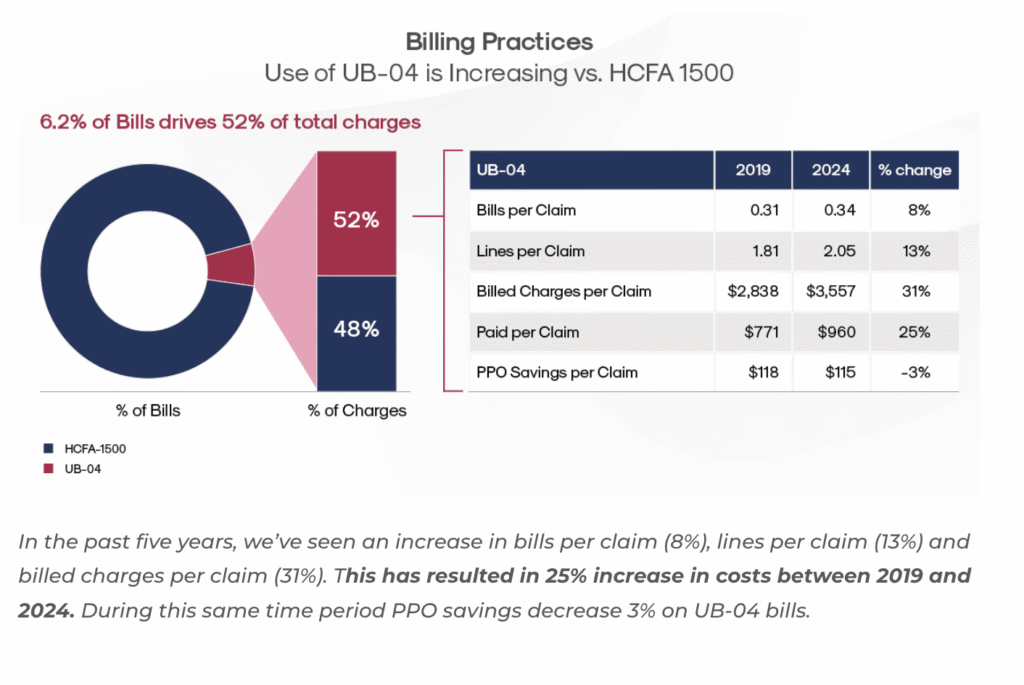
The medical billing landscape is undergoing a profound transformation with significant financial consequences, particularly for workers’ compensation systems. Provider organizations are strategically shifting from traditional HCFA 1500 forms toward UB-04 billing formats, a change that consistently yields higher reimbursements.
The impact is striking: In workers’ compensation, only 6.2% of bills are submitted using UB-04 formats, yet these bills drive 52% of total medical charges.
Key Trends:
- As independent practices are absorbed into larger health systems, they adopt more sophisticated billing methodologies, including complex procedure codes and additional facility fees.
- This billing evolution means identical medical services now often cost substantially more—not because the care itself has changed, but purely due to different billing classifications.
- Workers’ compensation fee schedules, designed for traditional billing patterns, frequently lack mechanisms to address these strategic billing modifications.
This systematic shift toward more complex billing practices directly impacts workers’ compensation costs, creating new challenges for claims management and cost containment.
Healthcare’s Triple Threat to Smart Spending: Medical Inflation, Provider Consolidation and Billing Practices
Examination of Diagnosis and Geography on Time to PT and Time to Surgery

Dignosis-Specific Patterns

Geographic Variations

Time to PT
- Case complexity and severity levels
- Treatment sequencing decisions
- Injured employee and provider preferences for initial treatment approaches
- Administrative and authorization processes
- Care coordination between providers
Diagnosis-Specific Patterns
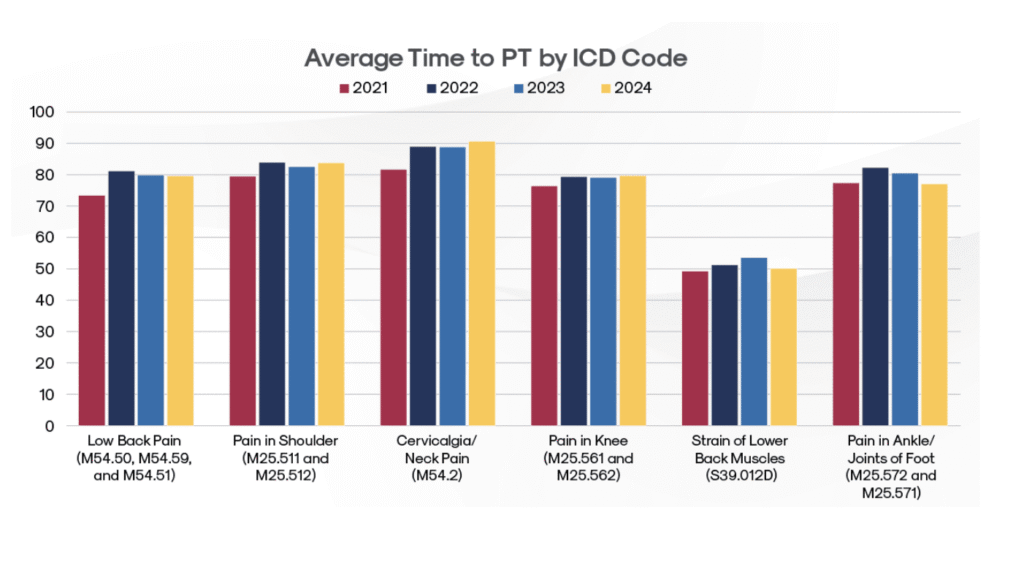
Pain-related cases often show longer times to PT initiation.
Key Insights:
- Neck injuries take the longest to get to PT among high-volume diagnoses. This typically reflects standard treatment protocols where patients first attempt alternative management.
- The distinction between more precise diagnoses of strain versus more generalized diagnoses of pain significantly impacts time to PT. Cases diagnosed as strain of the lower back (ICD S39.012D) reach physical therapy 37% faster than those diagnosed as lower back pain (ICD codes M54.50, M54.59 and M54.51). This marked difference likely reflects the clearer treatment pathway for acute strains, where early PT intervention is often prioritized, versus pain diagnoses which may first be treated through other conservative measures or require additional diagnostic workup to determine the underlying cause.
Geographic Variations
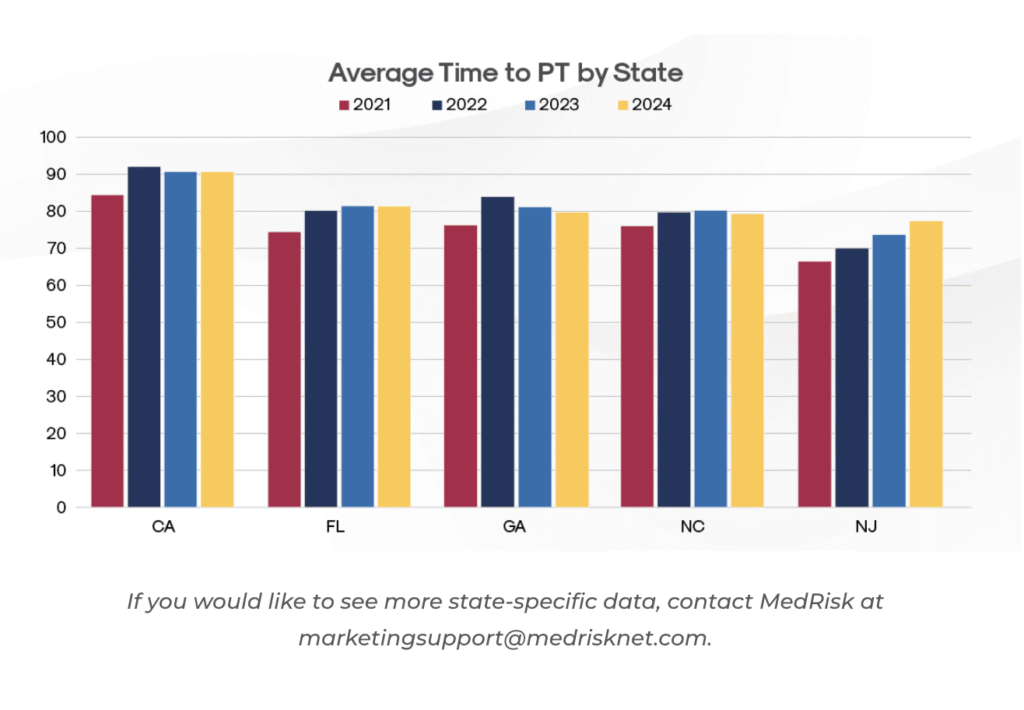
Analysis of the top five states by case volume reveals regional disparities in PT access:
Key Insights:
- California has the longest Average Time to PT at 90.7 days
- Florida follows with 81.4 days (11% faster than California)
- Pennsylvania (which is in the top ten states by case volume but not graphically depicted) demonstrates notably better Average Time to PT performance at 54.7 days (66% faster than California)
These significant state-level variations suggest that local healthcare delivery systems, regulatory environments, and claims management practices play a crucial role in determining how quickly injured workers access physical therapy services.
Surgical Rate Trends
Within the broader healthcare market, providers are increasingly favoring conservative treatment approaches before considering surgical intervention. This is supported by growing evidence that many conditions can be effectively managed through physical therapy and other non-invasive treatments.
Despite these broader market trends, we are not seeing a decline in surgical rate trends in workers’ compensation, with the proportion of claims requiring surgery remaining stable at approximately 24 percent of claims between 2021 – 2024.
Procedure-Specific Patterns
57%
8.5%
Geographic Variations in Time to Surgery
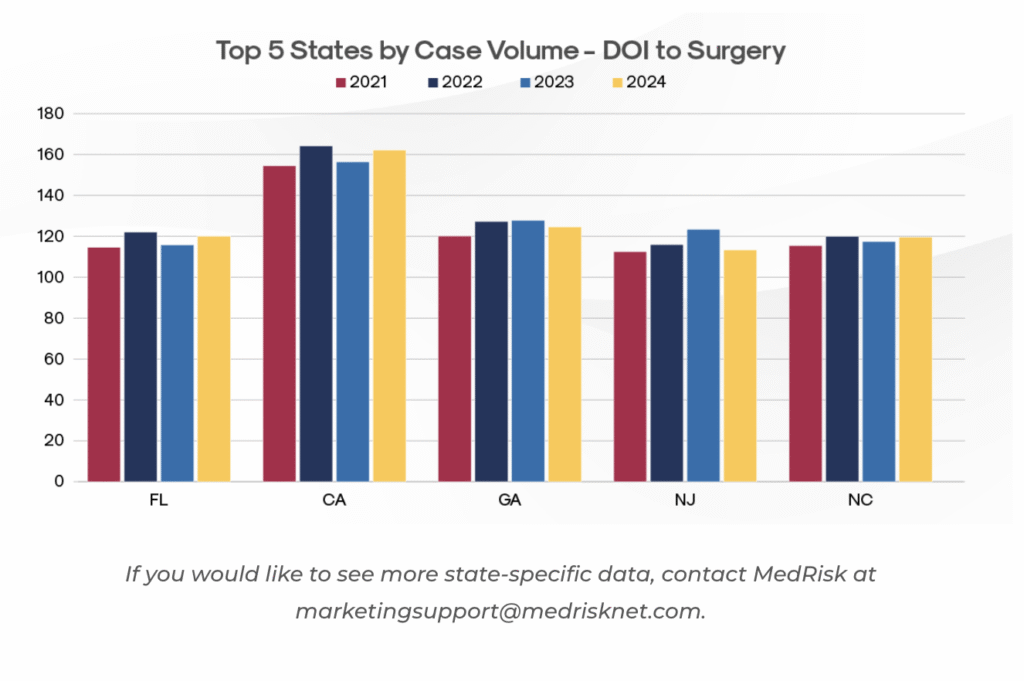
- California, which also has the longest Average Time to PT at 90.7 days, also shows the longest time from Date of Injury (DOI) to date of surgery (DOS) at 162.2 days. This time gap suggests systemic factors affecting both physical therapy and surgical care access in the state.
- California’s Time to Surgery rates contrast sharply with other high-volume states (FL, GA, NJ, NC) that average 119.4 days from DOI to DOS – 35% faster access to surgical intervention.
- Less complex authorization requirements for PT compared to surgery
- PT being a common first-line conservative treatment approach
- Lower barriers to scheduling PT versus coordinating surgical interventions
- Many cases successfully resolve with PT, eliminating the need for surgery
Research & Insights
Recommended Reading
Three Things We Think We Know About Workers’ Comp. Three Conversations That Challenge Them.
Some ideas become so accepted that we stop questioning them. Recovery means an injured worker is ready to return to

One Cupcake at a Time: Building Trust in AI
Claims leaders see what AI can do: faster decisions, better outcomes for injured workers, new leverage for adjusters. What they’re

Visit MedRisk at WCI 2026
If you’re heading to WCI 2026 in Orlando, be sure to stop by Booth 907 and connect with the MedRisk

Scaling Expertise in a Constrained Claims Workforce
The conversation around AI in workers’ compensation has covered familiar ground: staffing shortages, rising caseloads, and pressure on adjusters. These

The Value of Payment Integrity in Workers’ Comp
In workers’ comp, not all savings are created equal. Reimbursement strategies must be evaluated not just on low-cost unit price, but how they impact overall

MedRisk Supports Kids’ Chance of America at National Conference
Kids’ Chance’s purpose is simple: give kids of workers who have been injured on the job a chance at a
Conclusion: Adapting and Innovating for a Smarter, Healthier Future
MedRisk by the Numbers

558,870
Injured Workers Treated by MedRisk Providers
150K+
Total Network Providers in MedRisk Network
90%
% of WC Payers Who Choose MedRisk for Managed PT Services
Why Research Matters
The workers’ compensation landscape, as we’ve shown, is ripe with opportunities to optimize for both financial and medical
success. Progress thrives on out-of-the-box thinking, and we’ve pinpointed key areas where collective action can show its full
potential. Through collaboration, we can not only achieve improved financial results but also accelerate patient recovery, paving the way for a collective win.
At MedRisk, we’re constantly delving into research, analyzing data, and leveraging our long-standing expertise to turn these possibilities into concrete solutions for our valued customers and partners.